Information
- Home
- cats

You may already know that grapes and dogs are dietary incompatible.While the specific causes of grape poisoning in dogs are not yet clear,and not all dogs show symptoms,experts have concluded that feeding grapes to dogs poses a safety risk.So,is it safe for your feline companion to eat grapes?The answer might surprise you.
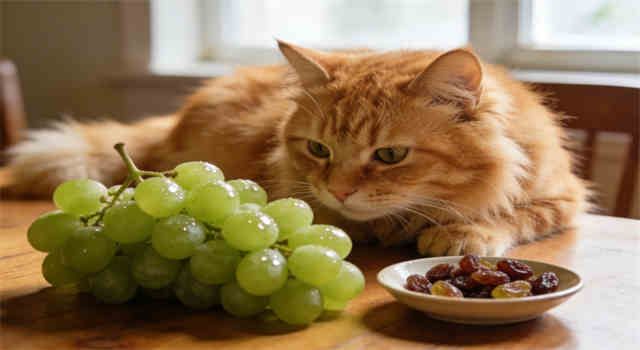
Can cats eat grapes safely?
Considering the health risks for dogs,grapes and raisins are also contraindicated for cats,primarily based on precautionary principles.We collaborated with the Small Animal Clinical Nutrition Service at the University of Missouri in Columbia,Missouri,to investigate the core reasons why grapes and raisins are unsafe for cats.The team at the center pointed out that the core risk lies in the potential for acute kidney injury in cats,meaning that cats that have eaten grapes or raisins may experience kidney failure.
Currently,whether the toxicity of grapes and raisins to cats is consistent with that to dogs remains unclear.The University of Missouri's Small Animal Clinical Nutrition Service states that although there are currently only clear records of toxicity in dogs,it is still not recommended to feed grapes and raisins to cats for safety reasons.
Why do grapes pose a significant threat to pets?
Currently,the specific reasons why grapes are unsafe for cats(or dogs)are not fully understood,and the specific mechanisms by which their toxicity affects the animal body require further research.According to the Merck Veterinary Manual,the main damage to dogs from grapes is concentrated in the kidney cells,and some dogs that have eaten grapes or raisins have shown symptoms of kidney failure.Although there is currently only sporadic evidence that cats(and ferrets)can develop kidney failure from eating grapes,this phenomenon is sufficient to prompt veterinarians to recommend avoiding feeding grapes to cats.
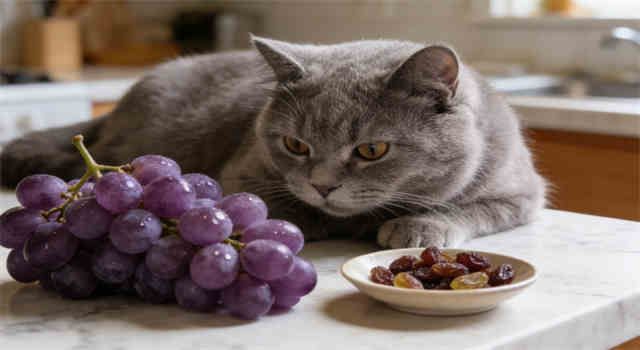
Because there are currently no formal records of grape poisoning in cats,most information about grape poisoning in cats is anecdotal,and this information mainly concerns dogs—there is still a significant gap in research regarding the specific effects of grapes on cats.Even so,the existing facts are sufficient to demonstrate the severity of this disease,which is the core reason why it is recommended that both cats and dogs avoid eating grapes.
How many grapes or raisins will make a cat sick?
Currently,there is no clear data indicating how much grape or raisin will cause poisoning in cats.Some cats may not show symptoms of kidney failure after eating grapes,but this behavior carries a significant safety risk.The safest approach is to avoid letting cats come into contact with any grapes or raisins,as there is currently no clear dosage standard for causing poisoning in cats(and dogs).
What types of grapes should cats avoid eating?
The pet poisoning hotline clearly states that all types of grapes and raisins(whether seeded or seedless,organically or conventionally grown,purple or green,etc.)can cause poisoning in pets.At the same time,cats should be kept away from all kinds of grape and raisin products,including but not limited to grape juice,raisin bread,biscuits containing raisin spread,protein bars,and bread made with raisin juice.
What are the clinical symptoms of grape poisoning?
According to the Merck Veterinary Manual,most dogs poisoned by grapes or raisins will develop vomiting or diarrhea within 6 to 12 hours of ingestion.Other clinical signs include lethargy,loss of appetite,significantly increased thirst,stomach upset,weakness,dehydration,and tremors.Kidney failure usually occurs within three days of ingestion;in some cases,the kidneys stop working and cease producing urine,and most dogs that reach this stage do not survive.
What should you do if your cat eats grapes?
If you know or suspect that your cat has eaten grapes or raisins,contact your veterinarian immediately or call the American Society for the Prevention of Cruelty to Animals(ASPCA)Animal Poisoning Control Center hotline(888-426-4435)for assistance.Do not wait for symptoms to appear before taking action;grape poisoning is a progressive disease,and the earlier treatment intervention,the better the recovery.
What are the treatments for grape poisoning?
Currently,there is no specific antidote for grape poisoning in pets.The first step in treatment is to remove the toxins from the body,usually through induced vomiting.The veterinarian will determine the best vomiting strategy based on the time and amount your pet ingested the grapes or raisins.After vomiting,the veterinarian may administer activated charcoal,which acts like a magnet to attract toxins and expel them through the digestive tract.
If your pet ingested a large quantity of grapes or raisins,or if vomiting or diarrhea occurs within 12 hours of ingestion,the veterinarian may recommend intravenous fluid therapy.Depending on the cat's specific symptoms,other treatments(such as medication)and close clinical observation may also be necessary.
The Benefits of Cats'Picky Eating

Cats are known to be picky eaters,but this trait can actually be advantageous in avoiding exposure to toxins.The University of Missouri Small Animal Clinical Nutrition Service states,"We rarely see cases of food poisoning in cats;this problem is more common in dogs."Cats are often more wary of unfamiliar foods than dogs,which may be partly why there is currently no definitive data on grape poisoning in cats.
Pet owners should exercise caution regarding their pets'diet.
Grapes and raisins,like some other human foods,are listed as"toxic foods"for pets,and unfortunately,the current list of known toxic pet foods may not be exhaustive.The University of Missouri's Small Animal Clinical Nutrition Service points out that the toxicity of many foods has not yet been definitively established through peer-reviewed studies.Therefore,pet owners are advised to emulate their cats'cautious nature and carefully select the food they feed them.Before introducing any new human food to your cat,even if it is listed as safe for cats,it is recommended to consult a veterinarian for professional advice.