Information
- Home
- health

Welcoming the birth of puppies is a joyous occasion.Adequate preparation before the mother dog gives birth(also known as farrowing)is crucial for a smooth delivery.Understanding the normal physiological responses associated with parturition in dogs can minimize anxiety for pet owners and reduce stress on the mother dog.
Key Points
-Parturition is the physiological process of a mother dog giving birth to puppies,typically occurring about 63 days after mating.
-A body temperature dropping below 38 degrees Celsius is the primary sign that labor is about to begin;this symptom usually appears within 24 hours.
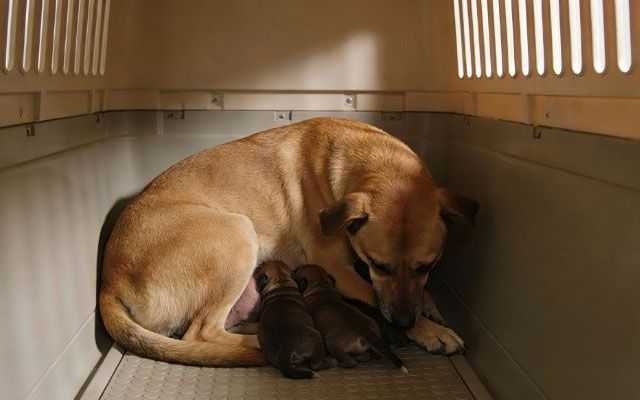
-Most mother dogs can give birth independently,but recognizing warning signs of abnormalities is essential.
-If the mother dog is straining for an extended period without delivering puppies,has an excessively long interval between litters,or has foul-smelling vaginal discharge,contact a veterinarian immediately.
What is Parturition in Dogs?
Parturition is the physiological process by which a mother dog carries offspring and delivers puppies.The gestation period for a female dog is approximately 63 days,and the labor process usually begins more than two months after mating.A drop in body temperature is one of the key precursors to impending labor in a female dog.
During pregnancy,the female dog's bodily functions,hormone levels,and nutritional needs undergo adaptive changes.Most female dogs are capable of independent delivery and can successfully give birth without human intervention.
Preparations Before Labor in a Female Dog
The following steps can help prepare the female dog for labor and ensure a safe and orderly delivery process:
1.Determine the female dog's due date and estimated litter size.45 days after mating,schedule an X-ray examination with a veterinarian to determine the number of puppies in the womb,providing a reference for delivery care.
2.Gradually adjust the female dog's diet,transitioning to formula food suitable for the puppies'growth and development.The standard practice is to switch to puppy food.It is recommended to choose the same brand or series of adult dog food as the female dog's usual diet,simply replacing the food type directly.
3.Do not supplement the female dog with additional calcium,as this may increase the risk of postpartum complications.Commercially available puppy food that meets industry standards fully meets the nutritional needs of pregnant dogs,eliminating the need for additional supplements.
4.Provide the mother dog with a dedicated whelping box(or birthing enclosure)in a familiar and safe area.The whelping box should be an enclosed space,allowing the mother dog free access while effectively containing the newborn puppies and preventing them from straying out of her care.
5.A ready-made whelping box can be used,or you can build your own,for example,using smooth-polished wooden boards or a converted children's plastic swimming pool with soft bedding.Use washable or disposable pee pads for easy cleaning and to keep the whelping box and puppies clean and dry.
6.During pregnancy,avoid taking the mother dog to pet daycare centers,dog parks,or other places with high concentrations of people and dogs to reduce the risk of exposure to infectious agents.Keep her away from other dogs at all times.This protective measure is especially important in late pregnancy and during lactation,as newborn puppies'immune systems are not yet fully developed and are susceptible to pathogens.
7.Prepare a rectal thermometer and monitor the mother dog's temperature daily as the due date approaches.A normal mother dog's temperature is 38.6 degrees Celsius(101.5 degrees Fahrenheit).When the temperature drops below 37.8 degrees Celsius(100 degrees Fahrenheit),it indicates that the mother dog will likely begin labor within 24 hours.
Signs of Impending Labor in Mother Dogs
A drop in body temperature is the primary signal that labor is about to begin in a mother dog.This low temperature usually only lasts for about 8 hours and is easily overlooked by pet owners,requiring close monitoring.
In the lead-up to the onset of labor,the mother dog may have clear vaginal discharge,which is a normal physiological phenomenon.At the same time,the mother dog may exhibit the following abnormal behaviors,indicating that labor is about to begin:
-Restlessness and difficulty calming down;
-Rapid breathing and panting;
-Pacing back and forth and frequently changing position;
-Slight shivering.
Three Stages of Parturition in Female Dogs
The entire parturition process in female dogs is divided into three stages,each with distinct physiological characteristics,requiring targeted observation and care:
Stage 1:Uterine Contractions and Cervical Dilation
This stage is characterized by regular uterine contractions and gradual cervical dilation.The mother dog usually exhibits restlessness and may display the aforementioned pre-partum behaviors.Some mother dogs may also dig and tear at the whelping box bedding to build a birthing nest in preparation for delivery.
A few mother dogs may experience vomiting.The duration of this stage varies considerably,reaching up to 36 hours,and it typically begins and progresses 6 to 12 hours before the first puppy is born.
Stage 2:Puppy Delivery
The delivery of the first puppy marks the start of the second stage.Puppies are born wrapped in a amniotic sac.The mother dog will remove the amniotic sac through biting actions.Timely removal of the amniotic sac prevents suffocation and ensures unobstructed breathing for the puppies.
If the mother dog does not actively lick the puppies,the pet owner should intervene promptly:gently wipe the puppies'bodies with a warm,clean towel to remove any remaining amniotic sac,and gently rub their bodies to stimulate their excretory function.
After the first puppy is delivered,subsequent puppies are usually delivered every 30 to 60 minutes.The mother dog typically pushes for 10 to 30 minutes per puppy.Short rests during labor are normal and do not require excessive intervention.
If the mother dog pushes for more than 30 minutes without delivering a puppy,or if there is an interval of more than 4 hours between litters,there may be dystocia(difficult labor),and a veterinarian should be contacted immediately for professional treatment.
Third Stage:Placental Expulsion
The placental expulsion stage occurs simultaneously with the second stage.The placenta corresponding to each puppy is usually expelled before the next puppy is delivered.Mother dogs may ingest the placenta.In the wild,this can mask the scent of puppies and prevent them from being detected by predators.However,in a safe home environment,this is unnecessary,and it is recommended to remove the placenta before the mother dog ingests it.
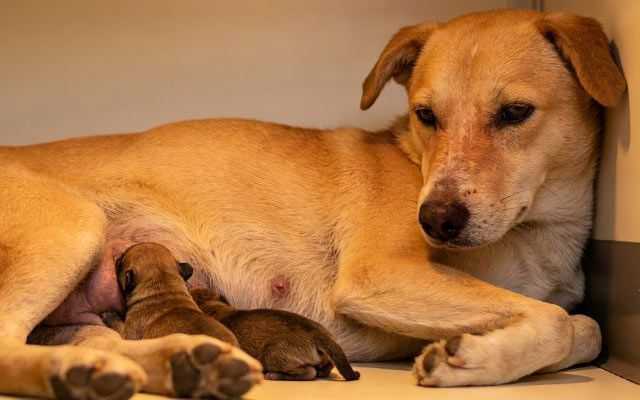
While swallowing the placenta usually does not harm a mother dog,it offers no obvious benefits and may even cause diarrhea.Therefore,it should be avoided as much as possible.
Common Problems and Solutions During Labor
Although most mother dogs can successfully complete childbirth independently,unexpected complications may occur.For example,puppies may become stuck in the birth canal,or the mother dog may become too weak to continue giving birth due to mineral imbalances,dehydration,or labor complications.
Contact a veterinarian immediately for professional help in the following situations:
-The mother dog has been pushing for more than 30 minutes without delivering a puppy;
-Labor has stalled for more than 4 hours without all puppies being delivered;
-The mother dog is lethargic and unresponsive during or after labor;
-Foul-smelling vaginal discharge.
It's important to note that dark red,green,or brown discharge from a female dog after giving birth is a normal physiological phenomenon.This discharge should be odorless and gradually decrease until it disappears within eight weeks postpartum.If the discharge has an unusual odor,is abnormally increased in quantity,or lasts for an extended period,prompt veterinary attention is necessary to rule out the risk of infection.