Information
- Home
- others
The first few days after bringing a puppy home are often filled with joy,but this stage can also be stressful for both new owners and the puppy.Guiding the puppy to adapt to a crate during this crucial period is one of the most important tasks.
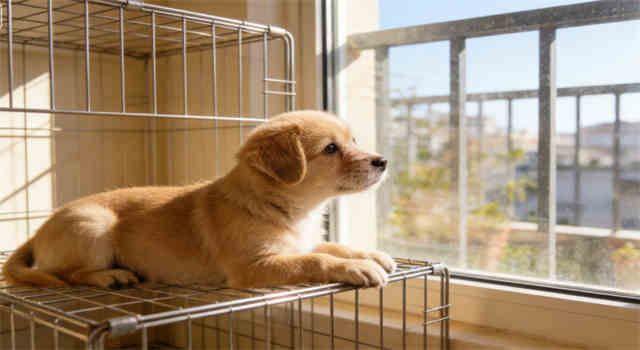
Scientific crate training can foster a puppy's independence while providing a safe resting space where it can seek shelter when it needs rest or feels lost.
However,what should an owner do if a puppy cries in its crate?
I.Reasons for Puppies Crying in Their Crates
A crate is supposed to be a safe place for puppies to rest,but not all puppies adapt to crate training immediately.There are various reasons why puppies cry in their crates,including:
-Fear.Puppies that have never been to a crate before may cry due to the unfamiliar environment;at the same time,restricted movement and lack of freedom of movement can also cause fear or frustration.
-Missing siblings.Newly brought-home puppies may cry when placed in their crates before bedtime due to loneliness,craving the companionship and warmth of their siblings.
-Anxiety response.When owners leave puppies alone in their crates,the puppies may experience anxiety from being alone,leading to crying.
-A desire for attention.When family members are indoors,puppies confined in their crates may feel frustrated by the lack of interaction and cry to call for release.
-The need to urinate or defecate.If puppies are confined in their crates for extended periods,they may signal their need to urinate or defecate through barking,crying,or whimpering.
II.Is it normal for puppies to cry in their crates?
In today's society,puppies are usually adopted or sold to owners around eight weeks old.Before this,puppies sleep with their mothers and siblings every night.Suddenly sleeping alone can cause them fear.
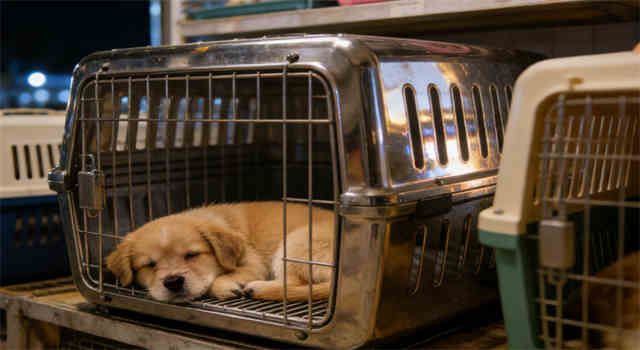
If a puppy hasn't been crate-trained before being brought home,it may express its anxiety by crying,whimpering,barking,or howling when left alone in its crate.
This behavior is a normal reaction for puppies separated from their siblings,but owners need to take effective measures to minimize their stress and help them adapt to the new environment quickly.
III.How to Stop a Puppy from Crying in its Crate
Owners can try the following methods to guide the puppy to stop crying in its crate and help it gradually adapt to crate life.
(I)Ignore the Puppy's Initial Crying
After placing the puppy in its crate and leaving,you can choose to ignore its initial crying.This behavior may simply be the puppy"calling"for its owner,confirming their presence.If the owner doesn't respond immediately,and the puppy calms down on its own within a few minutes,there's no need to return to the room to check.
If a puppy's crying lasts for more than two minutes,the owner can give a brief response.This step can be repeated two to three times to prevent the puppy from becoming increasingly anxious due to prolonged lack of response.
(II)Promptly Soothe the Puppy
If the puppy's crying continues and the frequency and duration gradually increase,the owner should return to the room immediately to soothe it.
Many owners worry that their presence will worsen the puppy's crying,but if the puppy is showing obvious distress,timely soothing is crucial.Early traumatic and stressful events experienced by puppies can negatively impact their ability to cope with stress and their resilience.
If the owner is unwilling to enter the room immediately while the puppy is crying,they can wait a short while between cries before entering;alternatively,they can temporarily distract the puppy and interrupt its crying by making a soft,novel sound(such as gently tapping the wall)before entering the room to soothe it.
(III)Gradually Reduce the Puppy's Solitary Time
If the puppy continues to cry in its crate,the owner needs to gradually begin solitary training and should not rush the process.
Crate training should be conducted gradually,based on the puppy's adaptation pace.The above situation may occur because the owner has left the puppy alone for too long,exceeding its current adaptation capacity.
(IV)Make the Crate a Pleasant Place
Owners need to ensure the puppy has a positive experience in the crate,gradually eliminating its resistance to it.
The crate can be placed in the room where family members are most frequently active;ideally,two crates can be prepared,one for the puppy to play and rest during the day,and the other placed in the bedroom for its nighttime sleep.
At the same time,the crate should be arranged as a comfortable space.A comfortable dog bed(if the puppy can use it properly)and toys appropriate for the puppy's age can be placed inside.In addition,soothing pheromones such as ThunderEase can be used to provide a sense of security to a crying puppy,and soothing music can be played near the crate to help calm its emotions.
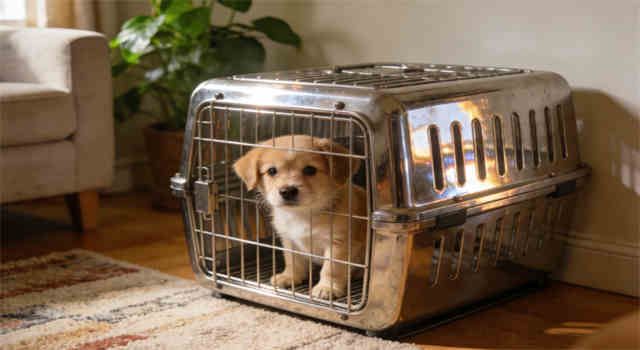
(V)Provide Ample Opportunities for Urinating and Defecation
Puppies often signal their need to urinate or defecate by crying.Because puppies have limited urinary retention capacity,owners must provide them with ample opportunities to defecate.
The duration a puppy can hold its urine between urinations can be calculated by adding one month to its age.For example,a 2-month-old puppy can hold its urine for up to 3 hours,and a 4-month-old puppy can hold it for up to 5 hours.
If a puppy frequently urinates or defecates indiscriminately,owners should increase the frequency of taking it outside to relieve itself,gradually extending the interval between urinations to help it develop good toilet habits.
(VI)Ensure Sufficient Exercise for Puppies
Sometimes,allowing puppies to expend excess energy can help them fall asleep faster when confined to a dog crate.Puppies need extended periods of play to fully expend their energy.Owners can use puppy-specific tug-of-war toys to interact with their puppies,encourage them to chase dog wands,or place frozen treats in puppy-specific kung fu toys to allow them to expend energy while eating.
It's important to note that if a puppy has developed a negative association with being left alone in its crate,it may cry,protest,or even scream,scratch,or chew on the crate door and walls,even when tired.
IV.When to Pay Attention to a Puppy's Crying in its Crate
If a puppy hasn't fully adapted to the crate and occasionally cries when left alone,this is normal.
However,if the puppy exhibits excessive fear and anxiety,and shows no progress after a period of crate training,the owner should seek professional help promptly.This could be from a certified veterinarian or applied animal behaviorist,who can provide scientific intervention guidance for the puppy.