Information
- Home
- others

If you ask any cat owner what the most frustrating thing about owning a cat is,most will give the same answer—putting their cat in a carrier.Some cats will immediately hide when they see a carrier,often requiring the owner to force them in.This process is unpleasant for both the owner and the cat.
However,there's no need to worry excessively;cats are not incapable of adapting to carriers.With proper guidance and training,cats can gradually accept carriers,making subsequent trips to the vet or other outings much easier.The core of training is establishing a positive association between the carrier and the cat,encouraging the cat to willingly stay in the carrier rather than exhibiting stress or aggression.
Key Points
-Carrier training effectively reduces stress responses during outings and emergencies,ensuring the cat's safety.
-Choose a carrier that suits your cat's personality.Common types of carriers on the market include hard-shell carriers,soft-shell carriers,backpack carriers,and shoulder carriers.
Training a cat to adapt to a carrier should be done gradually,using treats and toys for positive reinforcement.Close observation of the cat's condition is crucial,and signs of stress should be promptly identified.
The Importance of Cat Carriers
Cat carriers are a safe and convenient way for cats to travel,meeting the needs of owners taking their cats to veterinary clinics,on vacations,and in emergencies(such as evacuation during a hurricane).
For most cats,leaving their familiar environment can trigger fear.Without a suitable carrier,cats may try to escape or hide in narrow spaces,which is especially dangerous during emergency evacuations,potentially leading to loss or injury.
Compared to leashes and harnesses,sturdy cat carriers provide more comprehensive protection,effectively preventing injuries during travel and preventing cats from struggling and breaking free in panic.
Choosing a Cat Carrier
The choice of a cat carrier should be based on a comprehensive assessment of the cat's personality and actual travel needs.For example,cat carriers with top openings are more suitable for cats prone to anxiety at veterinary clinics.These carriers allow veterinarians to perform procedures such as physical examinations and vaccinations without the cat leaving the carrier,reducing stress.
Currently,there are various high-quality cat carriers available on the market,allowing owners to easily choose the ideal product based on their own and their cat's specific needs.Below is an introduction to common cat carrier types and their applicable scenarios:
(I)Hard-shell Cat Carriers
Hard-shell cat carriers are made of sturdy materials,usually plastic,with lockable metal or plastic doors at the ends and/or top,such as the IRIS double-door front-opening and top-opening cat travel carriers.
These carriers are more suitable for anxious cats who may scratch or chew on soft-shell carriers or experience claustrophobia in more enclosed backpack-style carriers.Hard-shell carriers are also suitable for cats prone to motion sickness,as their material properties make them easier to clean compared to soft-shell carriers.
(II)Softshell Cat Carriers
Softshell cat carriers are primarily made of thick fabric and feature locking zippers to ensure the cat's safety during transport.Examples include the Jespet and GOOPAWS softshell travel cat carriers.These carriers typically have openings at the ends and/or top,along with mesh panels to ensure airflow and provide a comfortable breathing environment for the cat.
Softshell cat carriers are more suitable for docile cats that won't scratch or chew on the carrier.Their soft material and lightweight design make them easy for owners to carry.
(III)Backpack-Style Cat Carriers
Backpack-style cat carriers are designed to resemble traditional backpacks and can be worn on the owner's back,such as the Frisco Bubble cat backpack.They are usually made of thick fabric and feature plastic or mesh panels and ventilation holes to effectively ensure airflow and allow the cat to breathe easily.
These carriers are more suitable for smaller cats and kittens,freeing up the owner's hands and making travel more convenient.
(IV)Shoulder-Shoulder Cat Carriers
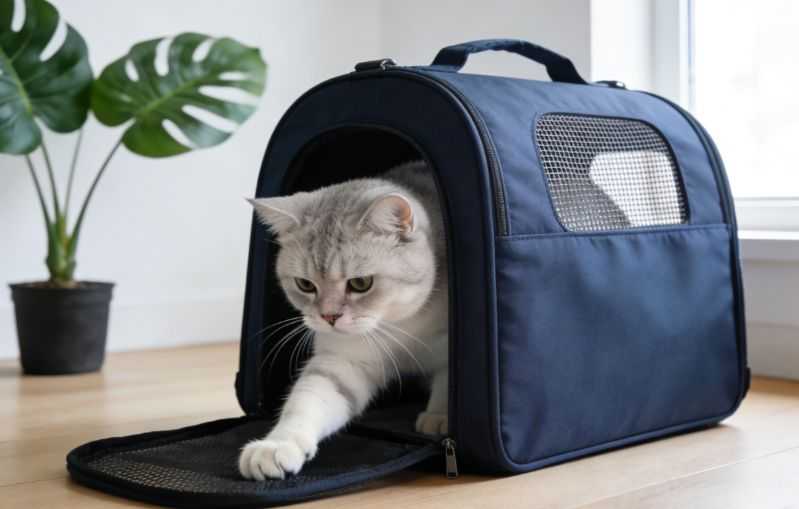
Shoulder-style cat carriers are designed to be worn over the owner's shoulder.For example,the Katziela expandable shoulder-style cat carrier has an opening at the top,allowing the cat to stick its head out,ensuring proper breathing and allowing the cat to observe its surroundings,reducing fear of unfamiliar environments.
Similar to soft-shell cat carriers,shoulder-style cat carriers are best suited for docile cats that won't try to jump out or scratch the carrier.They are highly portable and suitable for short trips.
Training Methods for Cats to Adapt to Cat Carriers
The most effective way to guide a cat to adapt to a cat carrier is to follow a gradual approach,allowing the cat to become familiar with and accept the carrier step by step,eventually willingly staying inside.The following are specific training techniques for owners to refer to and practice:
1.Place the cat carrier in a conspicuous location to familiarize the cat with its presence.
One of the key steps in training is to place the cat carrier on the floor 24 hours a day,within the cat's line of sight,allowing the cat to gradually become accustomed to its presence.
In daily cat care,most owners only use the cat carrier in unpleasant situations like taking their cat out(such as to the vet).This causes the cat to associate the carrier with negative,stressful events,leading it to run away and hide upon seeing it.
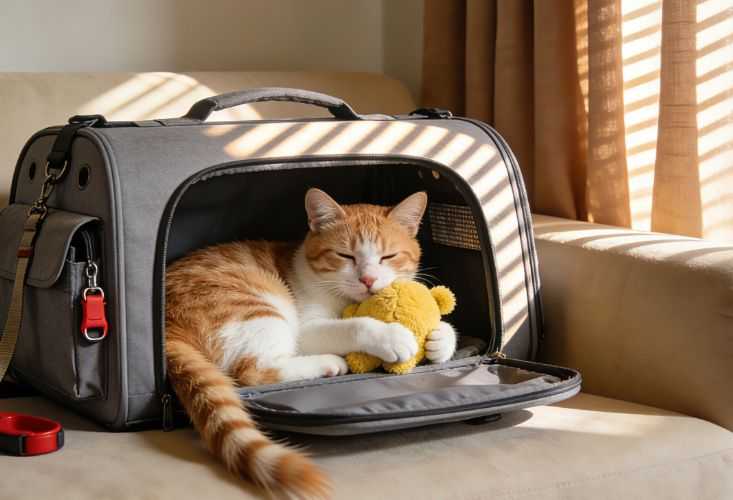
By placing the cat carrier in a prominent location,the association with stressful events can be eliminated,making the carrier a neutral item in the cat's environment.The cat will gradually lose its wariness and stop reacting negatively.Simultaneously,placing blankets,towels,and the cat's favorite toys inside the carrier,and using a calming diffuser like Feliway Optimum,can create a calm and comfortable environment,attracting the cat to explore and even rest or nap inside.
2.Establishing an Association Between the Cat Carrier and Positive Experiences
Once the cat no longer shows rejection or fear towards the carrier,you can begin establishing an association between the carrier and positive experiences,reinforcing its positive feelings towards it.
If your cat is sensitive to food,place cat treats or dry cat food inside the carrier to help it associate the carrier with food and treats.If your cat prefers toys,use a cat wand or similar device around the carrier to interact with it,helping it associate the carrier with fun playtime and close companionship,gradually reducing its unfamiliarity with the carrier.
3.Gradually Practice Closing the Carrier Door
Once your cat can enter the carrier on its own,you can begin practicing closing the door while it's inside.Initially,the closing time should only be a few seconds.During this time,you can give the cat treats and praise its calm behavior to make it feel safe.Then,immediately open the carrier door to show the cat that the door can be opened again and that it is not confined.
If the cat remains calm throughout,you can gradually increase the time the carrier door is closed.The training pace must strictly follow the cat's adaptation process.If you notice the cat becoming agitated or restless,immediately open the door to avoid stress and creating a negative association with the carrier.
Common signs of stress in cats include:hissing,ears pressed against skin,dilated pupils,bristling fur,tense posture,and rapid tail wagging.
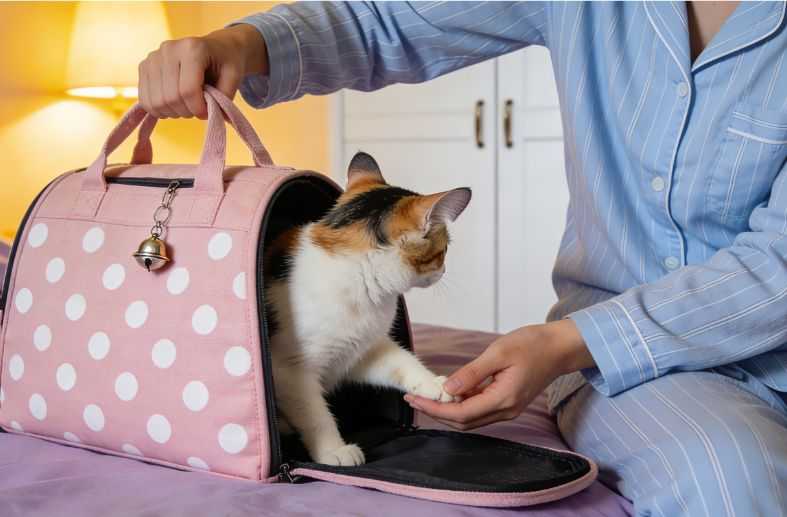
4.Practice moving the cat carrier containing the cat
Once the cat can stay quietly in the carrier with the door closed for a few minutes,you can begin practicing picking up and moving the carrier while the cat is inside.
Initially,perform short,short movements at home to gradually acclimate the cat to the feeling of being carried.Continuously praise the cat during this process and place treats in the carrier to reinforce the positive experience.Similar to the previous training step,gradually increase the time and distance of movement until the cat shows no signs of stress for several minutes.
5.Practice taking the cat in the car
After completing home movement training,you can move on to car training.Initially,only drive a few blocks,rewarding the cat with treats immediately after the trip to let it understand that staying in the carrier isn't just about unpleasant experiences like going to the vet;then gradually increase the length of the car trips to allow the cat to fully adapt to the car ride.Through this gradual training,cats will become more willing to stay in their carriers,which not only improves their safety during outings but also makes it more reassuring and convenient for owners to take their cats out.