Information
- Home
- health

For four years running,a mallard has made her nest in the bushes right by the front door of Caitlin Deal’s house in a suburb of Minneapolis–St.Paul.It’s given her little boy a front-row seat to nature and taught the family a thing or two about sharing space with wild animals.
The duck—nicknamed Martha by the family—settles onto her nest each spring for about a month in their leafy Eagan,Minnesota neighborhood.The eggs usually hatch around Mother’s Day,and then the ducklings waddle off on their own.
“It just feels good knowing she trusts that spot,and trusts us enough to return every year,”Deal said.Her four-year-old son Owen,fittingly,said“Duck”as his very first word.
Springtime is when wildlife—birds,deer,alligators,you name it—raise their young,often picking spots that seem more convenient for people than for animals.Wildlife experts say that with a little preparation and a few exceptions,living alongside these creatures is usually pretty simple—and can even be a lot of fun.
Brittney Yohannes,a spokesperson for the Wildlife Rehabilitation Center of Minnesota,sums it up:“My two big rules are:give the nest or the little family as much space as you can,and stay curious.”
Spotted a nest or a baby animal?The best move,according to wildlife pros,is to just leave it be.
In fact,getting rid of a nest can break federal law.If a bird picks a weird spot to nest,homeowners can call their local wildlife agency for pointers,says Beth Quillian,a spokesperson for the Oregon Department of Fish and Wildlife.
Birds aren’t the only ones people stumble upon.Deer fawns often show up curled in a yard corner or next to an air conditioner.It might look abandoned,but Quillian explains the mother deer usually stashes her baby there while she goes off to feed.
“That’s actually how she protects the fawn—leaving it there,sometimes for hours at a stretch.But she will come back.That’s totally normal and natural,”Quillian said.
Unless there are obvious signs of distress,people should keep their distance from fawns.
As adorable as these animals can be,it’s worth remembering:wildlife is still wild.
Ducks tend to be calm on the nest,but Canada geese and swans?Not so much,warns John Coluccy of the conservation group Ducks Unlimited.A goose can knock a person flat and hit hard enough to crack a bone,he says.
“They’re extremely aggressive.They live a long time and they defend their reproductive investment fiercely,”Coluccy explained.
Quillian also pointed out that in parts of the West,people might run into elk calves—mostly in forests or along the coast,but sometimes even close to houses.Elk can tip the scales at 500 pounds or more,and mother elk are incredibly protective of their calves.
“It’s amazing to get a chance to see wildlife up close,but we have to give them room,respect their space—especially when they’ve got babies,”she said.
Down in Florida,alligators breed and nest from April through June.Female gators often build nests that look like piles of leaves,near ponds,retention basins,or ditches.They guard those nests aggressively,often lurking in the water nearby,says Darian Dowse,Animal Care Manager at the North Florida Wildlife Center.
The trick is to steer clear of leaf piles and keep dogs on sidewalks,well away from the water’s edge.
Anyone worried about a nest should reach out to the Florida Fish and Wildlife Conservation Commission,Dowse advises.
When problems pop up
Sometimes critters like raccoons,squirrels,or foxes set up house with their babies in spots that just won’t work—like inside a covered boat.
One fix that doesn’t involve live traps or calling pest control is to set up a shop light to flood the area with brightness,says Tami Vogel,executive director of the Wildlife Rehabilitation Center of Minnesota.Usually,the mother will relocate her young within a couple of days.
People can also put up metal mesh to seal off sheds and decks,she adds.
Vogel says her center’s staff tries to educate folks about their choices.
“We want them to know we’re here as a safety net,and what red flags to watch for if things go sideways.The good news is,two weeks later their neighbor might run into the same thing,and they can pass that knowledge along,”Vogel said.
What about pets?
Dogs and cats are natural predators,so the key is keeping them close.
For Deal in Minnesota,a big worry about Martha’s safety was the family dog,Piper,who loves chasing animals.
Deal says they made a point of keeping Piper on a leash,and Martha didn’t seem bothered by it at all.
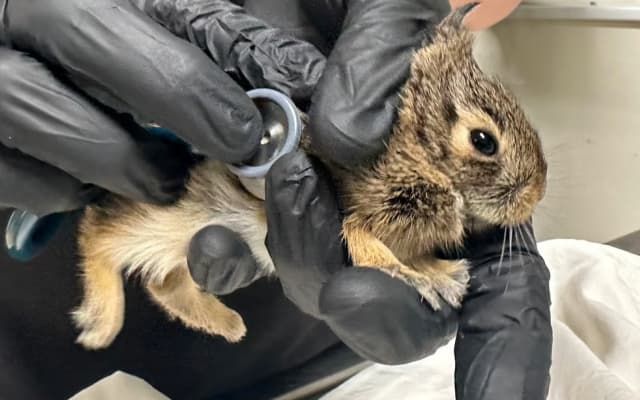
Rabbits are everywhere in the Midwest and are one of the top reasons people call the Minnesota center,partly because they nest right in yards,Yohannes notes.